By: Jennifer Hosler
Psalm 72: 1-7, 10-14; Isaiah 60:1-6; Matthew 2: 1-23
When I was growing up, my non-religious family celebrated Three Kings Day, which is what Epiphany is known as in some cultures. My mom would typically bake a cake and insert little wax-paper-covered coins in the cake, so that whoever found a coin in their slice would be “King” or “Queen” for the day. (I’m not sure it had much more significance than the title!)
Epiphany is one of the three oldest feast days of the church, alongside Christmas and
Easter (Britannica, 2024). This is something Christians have observed for thousands of years.
What does Epiphany mean? Epiphany comes from a Greek word which means “manifestation”.
We know the English word Epiphany as meaning when we have a sudden understanding or
revelation of something important. Epiphany commemorates the first revelation or manifestation
of Jesus the Christ to the Gentiles, the Magi from the East. As most of us are Gentiles or non-Jews, we stand in the lineage of the Magi who worshipped the infant Jesus.
According to church history, our gospel writer is Matthew the tax collector, one of Jesus’ disciples. Matthew is a Jewish author and brings a Jewish-focused lens to his presentation of the Good News of Jesus the Christ. Yet Matthew also “strategically brings Gentiles into his account from the outset and portrays them in strongly positive terms” (Anabaptist Community Bible).
Matthew’s gospel and the “Christmas story” is very different from that depicted in the gospel of Luke. The gospel of Luke is the Pageant text, with the scenes of Zechariah and Elizabeth, Mary and the angel Gabriel, Mary and Elizabeth, Mary’s Magnificat, the census, the journey to Bethlehem and no room at the inn, and the manger. In Luke, the heavenly host of angels appear to the shepherds, and we get our Glorias! The shepherds tromp over to the cave or stable, and glorify God, while Mary takes stock of that has occurred. Important note: no wise men or Magi in Luke.
The gospel of Matthew takes a different approach, perhaps a little short on the storytelling when it comes to Christmas. Matthew starts with genealogies, going from Abraham to King David and then, eventually ending with Joseph, husband to Mary, who bore Jesus the Messiah. After the genealogy, Matthew then turns toward the birth of Jesus, with the camera lens distinctly focused on the person of Joseph. Joseph is engaged to Mary and becomes pregnant by the Holy Spirit. Joseph, said to be a “righteous man,” doesn’t want to “humiliate” her and decides to quietly end their engagement. While he is considering this, an angel of the Lord visits Joseph in a dream, naming him as “Joseph, son of David” and telling him not to be afraid, and to marry Mary, since the baby has come about through the Holy Spirit. The angel says, “you will call him Jesus because he will save his people from their sins.” Matthew quotes Isaiah, a prophetic scripture, to provide context for this virgin birth, and the scene transitions with Joseph waking up. He marries Mary but doesn’t sleep with her until she gives birth to a son, whom Joseph names Jesus, as instructed. The birth narrative itself is a sentence, tops.
This sparse Christmas story is what Matthew decided he needed to fit the theological message he was going to tell. Again, Matthew was Jewish and, according to commentators, his audience was clearly a Jewish audience. The genealogy from Abraham to David to Joseph, the angel greeting Joseph as “Joseph, son of David,” and the scripture: Matthew is lining up the Jewish Messianic puzzle pieces. David was, of course, a king. In Jesus’ day, Messianic fervor had been growing, as people yearned for a future deliverance of God through a Messiah, a righteous King in the line of David.
Our passage today starts out, “In the time of King Herod.” At the time Jesus was born, King Herod I was a Roman client King over Judea. Herod identified as Jewish, but he wasn’t considered very religious. Herod appointed “lackeys” as priests who would do his bidding, killed anyone he thought was against him, and brutally enforced the occupation’s “Roman peace” in his territory (Jewish Virtual Library, 2024). Herod was a decadent and ruthless tyrant who built many fortresses and expanded the Temple Mount.
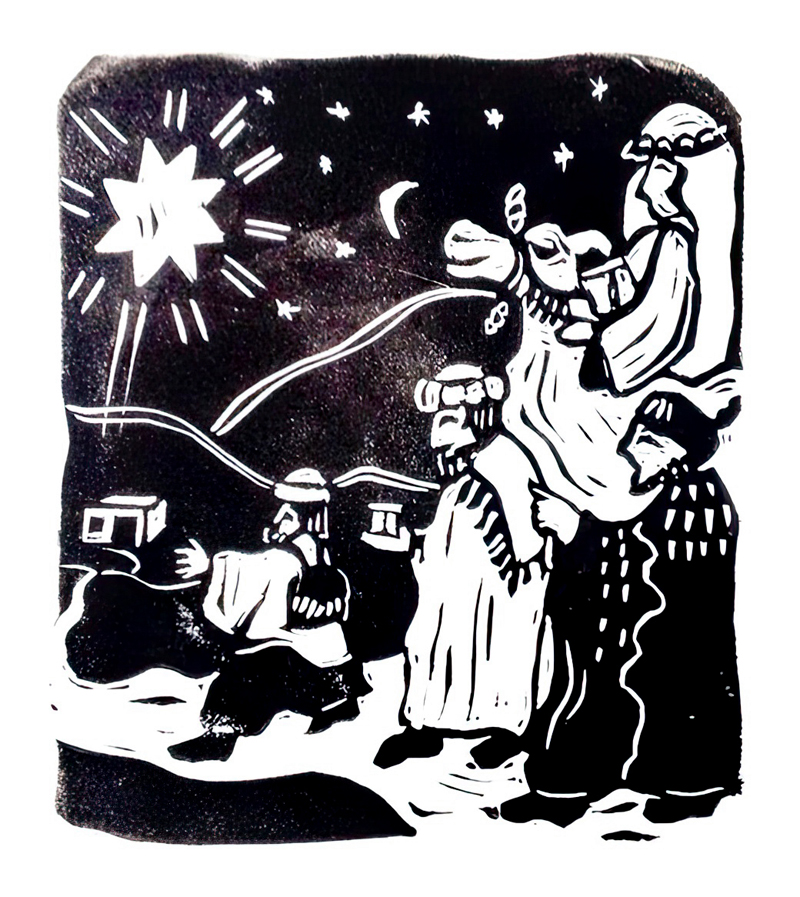
Back to the text: “In the time of King Herod, after Jesus was born in Bethlehem of Judea, magi from the east came to Jerusalem” (Mt 2:1). Herod is King over Judea, Jesus is born, and the magi arrive at an indeterminate amount of time after said birth. While Christmas scenes and nativities often have the Magi or Wise Men or Kings depicted bowing in front of newborn Jesus, alongside the shepherds and angels, this was not the case. Jesus, already born, and the magi arrive. The magi enter Jerusalem, asking, “Where is the child who has been born king of the Jews? For we observed his star in the east and have come to pay him homage.”
The magi, from Persia (modern day Iran), are astrologers or perhaps even Zoroastrian priests. They have traveled about 1000 miles after observing a star, likely preparing for their long journey with an elaborate entourage. The text does not specify the number of magi; it was probably more than three.
Imagine a Roman backwater regional capital with a vicious tyrant. Wealthy, learned foreigners from outside the Roman Empire arrive with their entourage, seeking to pay homage to this child born king of the Jews. Word gets around to King Herod but, rather than being enraged, Herod is frightened and terrified. Perhaps Herod knows his rule is illegitimate under God’s eyes or because he’d be in deep trouble if the Romans got wind of disorder or unrest. The people of Jerusalem are also frightened and terrified because they know that a scared Herod likely won’t lead to good things. Possibly because they don’t know what these magi speak of. Is a Messiah born? Is there a child? What will Herod do? Who are these people and what is this star that they speak of?
Herod does one thing right: when your rule is threatened by a potential legitimate heir to the throne of David, what do you do? Research. Herod calls the chief priests and scribes and orders them to research where the Messiah was to be born. The answer is Bethlehem. In secret, Herod orders the magi to be invited to his presence. Herod meets with them and learns when the star first appeared in the sky. Herod then provides the magi with the location of Bethlehem, encouraging them to go and find the child and report back, so that he might “also go and pay him homage.”
The Magi travel from Jerusalem to Bethlehem, about 6 miles. The star which prompted their journey (that they had seen in the east) appears again and then, miraculously, stops over the
place where the child is. When the Magi see the star, they are ecstatic. The King James translates this “they rejoiced with exceeding great joy” and the NRSVue says that they were “overwhelmed with joy.”
The Magi entourage arrives at a home in Bethlehem, perhaps the place where Mary and Joseph have decided to settle in before eventually making the trek north back to Galilee. Babies are tricky to travel with in any millennium and traveling postpartum with an infant was likely not a good idea. Some scholars think, if the magi saw the star, got ready for their journey, made their journey, and arrived in Jerusalem, Jesus could have been months old or even more than a year.
On entering the house, the Magi see the child with Mary his mother. They kneel down and “pay him homage”. Homage is “a physical display of reverence for royalty or a God.” In front of this toddler-sized King of the Jews, the Magi offer physical deference, allegiance, honor, and respect. After these acts of homage, the Magi open their treasure chests and offer symbols of wealth and opulence worthy of royalty. Portable valuables: gold, frankincense, and myrrh. Gold is obvious for its value. Frankincense is incense. Myrrh is a fragrant resin that was often used for medicinal purposes.
After the Magi complete their homage and gift-giving mission, they depart. Warned by a dream not to go back to Herod again, the Magi take a different route back to their home country. Spirituality, Emotions, Actions
While the story of the Magi is one that I have heard many times, I tried to spend time meditating on the spirituality, emotions, and actions present in this text. I want to lead us through a reflection on them and give space for you to reflect and even share what emerges for you.
I want us to think about the spirituality of Matthew’s gospel. By spirituality here, I mean something more like the awareness of transcendence, awareness of God being at work beyond what we can see. In Matthew 1, Joseph was discerning was the ethical action was regarding his relationship with Mary. Through an Angel in his dream, he sees God at work in the supposed scandal of Mary’s pregnancy. Joseph is aware that God acts in transcendent ways, so of course a dream could be from God.
The Magi certainly must have had a heightened awareness of transcendence, with their recognition of divine actions being expressed through signs in the stars and planets. A revelation of God occurs in the form of a new star – and they embark on a journey across a continent to find a small child who is King of the Jews. The Magi hear warnings in a dream and avoid a second encounter with Herod, while Joseph too learns about coming danger in a dream. He and his tiny family must flee the country to escape the coming wrath of King Herod. Stars and dreams are places where God works. Dreams and visions, signs and wonders.
I don’t have a detailed theology about stars or dreams to share in any type of prescriptive way – but pastorally and personally, I know that I want to heighten my awareness of the transcendent. I want triggers or reminders that the holy is at work in this world beyond what I can see. Perhaps we should be asking ourselves, how can we cultivate awareness of transcendence, and open ourselves to the Spirit’s movement beyond what we can see?
The emotions of Epiphany are also something I’ve been pondering and, in this text, they run the gamut. We see terror, dismay, and deep foreboding. These are the emotions rampant in Jerusalem when the Magi arrive. We also see “exceeding great joy” and exultation in the revelation of the star. We see reverence. After the joy of paying homage, there is again foreboding, deep grief, trauma, and unimaginable loss when Herod massacres the innocents.
I don’t have words to describe the emotions of the past 15 months or so but seeing both fear and foreboding and joy and grief all bundled together feels about right for our world and our country. We don’t know what lies ahead in this administration and the pain it will bring. We don’t know how we can convince our elected officials to stop funding a genocide. At the same time, we are humans and find joy and laughter and love. While God is with us in our suffering, we also have the hope and joy of Jesus Immanuel. This place is bleak – and God still came here to be with us, to lead us into the path of redemption. We are not alone, and God is at work. There is news of great joy, even amidst the suffering.
Finally, I am pondering the actions of the Magi. The Magi sought after the holy and then marched across the world after it. The road was certainly not smooth. And they came, encountered a tyrant face-to-face, sought out the presence of the newborn King, and they worshipped. Adoration, prostration, true homage – this isn’t something we lean into a lot here, though sometimes I raise my hand in worship. God with us: Immanuel. Jesus is worthy of prostration, in prayer or worship, or of hands raised high. Should we be spending more time and effort in adoration and paying homage to the Maker of the Universe?
I confess I don’t know how to lean into all this; but I am hungry for the Transcendent and I know I need to be more present – aware about my emotions. I want to act in faith and seek out opportunities to worship, pay homage. Our present reality is, in some ways, not that different from that of the Magi, we have an incongruent mix of political terror, intrigue, violence, holy wonder, and spiritual revelation. And we have God with us – Immanuel. The Messiah, King of the Jews, Light to the Gentiles, and Savior of the World. AMEN.
Art by Hochhalter, Cara B. (2019). The Magi, from Art in the Christian Tradition, a project of the Vanderbilt Divinity Library, Nashville, TN.
 Washington City Church of the Brethren