
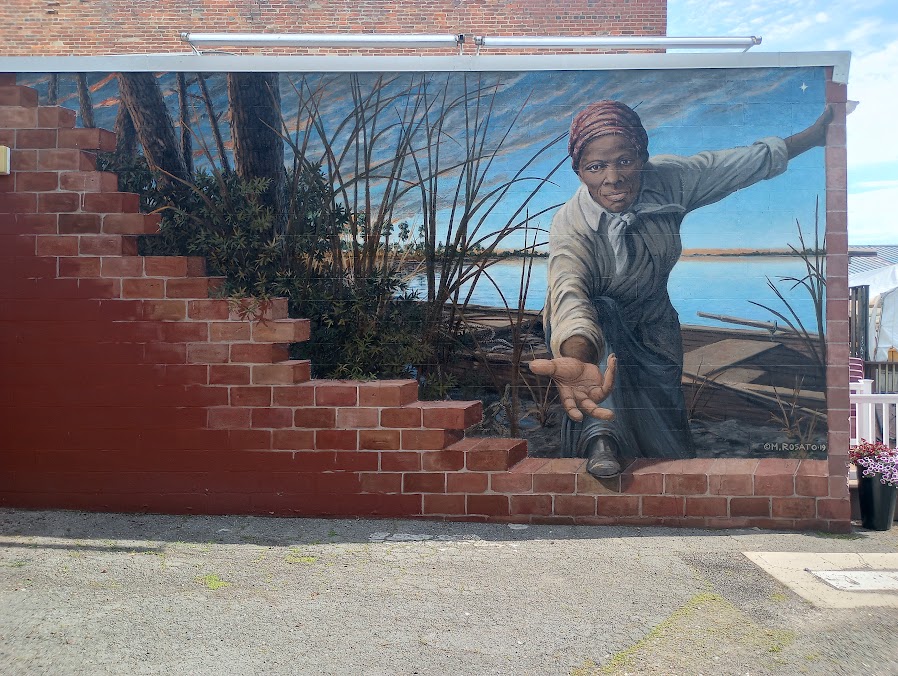
Mural by Michael Rosato in Cambridge, Maryland
By: Dana Cassell
Luke 4:14-21
This past summer – actually, during a trip up your way to preach with y’all in June – I spent some time on the Eastern Shore. While I was there, I visited the Harriet Tubman Underground Railroad National Park. It’s located way out there, in the middle of marshes and a national wildlife refuge because that’s where Tubman was born and raised, where she escaped slavery, and where she returned time after time to liberate her family and friends and community.
Maybe you’ve been out there. If not, I highly recommend a visit. It is an immersive experience, and it changed my entire understanding of who Harriet Tubman was. She is one of those figures that you learn about in childhood as part of American history, but like most radical people, her legacy has gotten whitewashed in the telling. Harriet Tubman was a straight up BADASS.
Born into slavery as Araminta Ross, the woman we know as Harriet Tubman suffered what we’d call today a traumatic brain injury early in life when an overseer tried to hit someone else with a heavy metal weight and hit her in the head, instead. The incident left Harriet with spells of dizziness, headaches and narcolepsy throughout her life. But it also was the start of her lifelong visions and dreams that she was very clear came directly from God.
On her first attempt to liberate herself, she fled with her brothers, who got cold feet and persuaded Harriet to turn around. On her second attempt, she succeeded. After she managed to orchestrate her own freedom, she returned to the Eastern Shore THIRTEEN times to liberate her family, friends, and community. She led more than 70 people out of slavery, through the Underground Railroad.
That is often where Harriet’s story ends when I hear it told, but her life kept going: She conspired with John Brown around his raid on Harper’s Ferry. She became a spy for the Union army and led a raid on huge plantations on the Combahee River in South Carolina, an action that liberated SEVEN HUNDRED more people from slavery. She lived out her days in the community of liberated people she created in New York State. She convinced her church in New York to open a home for the elderly. She was active in the movement for women’s suffrage.
Beginning in 2016, the federal government made plans to put Harriet on the $20 bill, replacing Andrew Jackson. It still hasn’t happened.
Harriet Tubman was a badass. And she was also an ordinary person who simply did what she knew was right. She said over and over that God meant for her and everyone else to be free, and that it was God who showed her when and where to go to make that happen.
Visiting the National Park out there on the Eastern Shore changed my view of Harriet. I didn’t know, for instance, that she was such a deeply religious person who talked constantly about being led by God in visions. I didn’t know that her first attempt at liberation was stymied by her fearful brothers. I didn’t really know much at all about her work as a military spy, and I didn’t understand that the THIRTEEN trips she made back to the marshes and swamps of her home were all to liberate people she KNEW.
Harriet’s courage and liberatory work was, it turns out, both much bigger (SEVEN HUNDRED people liberated from those SC plantations!) and much smaller than I understood. She was a national figure and has become a national myth, but her work began because she knew she was meant to be free, and once she accomplished that she expanded that liberation out in the logical concentric circles of her own network.
Tubman went back to the same place, over and over. She liberated her siblings, her friends, her own community members. She worked with people on the Underground Railroad all across the East Coast, yes, but she also maintained her connection and networks in the place she knew most intimately, the people she knew best.
//
Just like Harriet, Jesus also went *home.*
In the passage we read from Luke’s gospel this morning, we find Jesus doing the same tiny, enormous work. He has been traveling around the Galilee, teaching and preaching everywhere people would listen, and he has now arrived back in Nazareth, his own hometown. He visits the local synagogue, filled that day with his own family, friends, caregivers and community, walks up to the bema and reads from the ancient scroll of Isaiah.
The words Jesus reads are from Isaiah 61 and Isaiah 58, part of a beautiful, expansive vision of the new world order that God has promised to bring about. “The Spirit of the Lord is upon me,” Jesus reads,
because he has anointed me
to bring good news to the poor.
He has sent me to proclaim release to the captives
and recovery of sight to the blind,
to set free those who are oppressed,
to proclaim the year of the Lord’s favor.”
THAT is a gigantic directive, don’t you think? To feel the Spirit anointing you to bring good news to the poor, proclaim release to the captives and sight to the blind, to free the oppressed? It feels daunting even saying it out loud. It’s the stuff of messiahdom, saviorhood. It’s cosmic, new world order stuff.
And then Jesus looks up at all these people who’ve known him all his life, who wiped his butt and tended his scraped knees and watched him awkwardly navigate puberty, and he says to them: “Today, this scripture has been fulfilled in your hearing.”
And I imagine that the gathered crowd there in the synagogue at Nazareth felt similarly to what Harriet Tubman’s brothers must have felt when she proposed her liberation plan to them: “Nah. Not you. Not us. This is too big, too cosmic, too heavy a lift for it to happen HERE. We’re not courageous enough. You’re not strong enough. This is too much to ask of us, to believe that liberation could be for US, here and now.”
I imagine that Jesus’ family and community heard him quote the ancient prophet’s vision for a new world, witnessed him claim that identity and vocation for himself and narrowed their eyes, shook their heads and refused to believe it could be real.
Next week’s gospel gives us more insight into how they acted on those feelings. Spoiler: it wasn’t great. They ran Jesus right out of town.
And, if I’m honest, I get it. I empathize with those Nazareth people. To be invited into the work of liberation is kind of terrifying. I get anxious just leaving my house sometimes; much less doing dangerous things like defying the powers that be or helping to build illegal, underground networks of care for the most marginalized. That stuff is DANGEROUS, you know? I would rather keep my head down, sit at home, read more books and fly entirely under the radar. I could easily have been one of the Nazarenes who chased Jesus right out of town.
But you know what? Learning more about Harriet Tubman has helped me understand this divine invitation to the work of liberation a little better. Getting to know the real story of her actual life has, weirdly, eased some of my massive anxiety about getting involved in upending the world. Harriet Tubman was a badass, yes.
But she was also just a person, and the work of liberation she did was rooted and anchored in her own context, the reality of her known world. Harriet found her way to freedom through the marshes and swamps that she’d known her whole life. She didn’t fling herself far and wide to liberate other enslaved people, either: she returned HOME thirteen times. She knew that place. She knew those paths. And, maybe most importantly: she knew those people.
Jesus did the same thing: when he was ready to begin his big public ministry, you know where he went? Home. He announced the year of the Lord’s favor right there in his childhood synagogue. His ministry begins in Luke’s gospel in his hometown. In John’s gospel, he comes out as the Messiah while he’s at a family wedding with his mom.
This is ironically reassuring to me: that when we are invited into God’s great, cosmic, world-upending work of liberation and freedom, we aren’t necessarily being invited to change up much of our material circumstances. We’re not necessarily being invited to move far away, or instructed to learn entirely new contexts. We don’t necessarily have to uproot ourselves or navigate unfamiliar cultures or power structures.
It is possible that entering into the work of divine liberation begins exactly where we are, right here and right now.
Which, to be honest, might be even more terrifying than it is reassuring. Because not everybody will be on board. We might get convinced to turn back and abandon our attempts. We might even get run out of town.
But Harriet tried again, and ended up liberating not only herself but nearly EIGHT HUNDRED other people. Jesus’ ministry continues, all over the region. It’s true that both of their human lives ended up taking them far from their roots, but it is also true that everything began at home.
I suspect that joining in the work of being good news for the poor, participating in the work of liberating captives, learning how to see and inviting others to leave their own blindness is much, much smaller and more familiar than we think. I suspect that God loves making mountains out of molehills, transforming our tiny attempts at mercy and justice into earth-shattering works of transformation.
I am curious what that might mean for me, for you. What good work there is for us to be about right where we are, here and now. Not some big, chaotic uprooting of our lives, but small, familiar actions whose power we might barely even register. Mustard seeds. Small things with great love. Molehills made into mountains. Our own longing to be free ourselves leading to scores of other people being liberated.
 Washington City Church of the Brethren