Preacher: Jennifer Hosler
Scripture: Isaiah 11:1-10
This week, I was catching up with a parent at my kid’s school, knowing that they had visited their older adult parents over Thanksgiving and that they were tasked with hosting an extended-family-Thanksgiving. I asked how it went and he said, “I don’t know why we always put it on ourselves to do so much, so many dishes, cooking all day.” I’m sure there is a mix of tradition and expectation and delight and obligation and felt duty that all combine together there – plus a sense of accomplishment and joy (hopefully) when all is said and done and plates are polished.
We all have certain typical or traditional actions during holidays. Why do we do what we do? I suppose another word for that is mindfulness, being aware of our hearts and state of mind, asking ourselves what we are feeling and what our intentions are, if a given tradition is even serving us well.
Why do we “do” Advent? In this congregation, we’ve been doing it for years, as long as I’ve been here (since 2012) and beyond. Outside of our little church, Christians have been doing Advent for a very long time. Researchers and historians have found records from early church leaders in the 400s and 500s with instructions about fasting before Christmas. There is a text from the 300s about the need for extra church going in December – more specifically, there are instructions not to be absent from church for 21 days!
The word Advent comes from the Latin adventus, which means coming. Advent is the season of expectation for the coming of Jesus. The purpose of Advent is two-fold, to prepare ourselves to celebrate the birth of Jesus (the first coming) and to prepare ourselves for the second coming of Jesus.
The scriptures chosen for the Revised Common Lectionary in Advent are not what our world would typically think of as “preparing for Christmas.” Our Advent scriptures build on a tradition where “preparation” for Christian holidays involved fasting, prayer, and repentance, not Christmas cookies and glittery trees.
Last week, the scriptures included weapons of war, strong language about right living for the people of God, and Jesus talking about the apocalypse. This week, we have imagery of tree stumps and the story of what seems like a crazed desert preacher who is dunking people in water. Tree stumps in Advent – kind of the opposite image of the cultural Christmas tree. (what if we brought in an ugly tree stump as our Advent image instead of a beautiful full tree?!)
Advent scriptures vary between prophetic texts and royal Psalms and New Testament apocalyptic messages. As I wrote about in my brief newsletter reflection, when Nate and I reviewed this year’s cycle of texts for an overarching theme, we saw the theme of God’s Shalom woven throughout. Our church’s tagline is “Seeking justice, wholeness, and community through the gospel of Jesus.” The word wholeness in this tagline comes from the Hebrew word for peace: shalom. Shalom infers more than the absence of violence but also includes wholeness, completeness, right relationship, and holistic well-being.
The shalom evident in Advent scriptures includes justice for the poor, a foretold righteous ruler defined by justice and faithfulness, a world where weapons are transformed into life-giving tools, a world where there is ecological wholeness and healing, and much more. There is confusing apocalyptic imagery and beautiful messianic imagery – all pointing to a yearning for God’s inbreaking in this world, a yearning for God to bring healing to all created things.
Advent is the season to look toward God’s hope, God’s refusal to stand far off but to instead come, intimately, at risk, and in the flesh, into our world of injustice, pain, greed, and loss. Jesus, Immanuel: God with us.
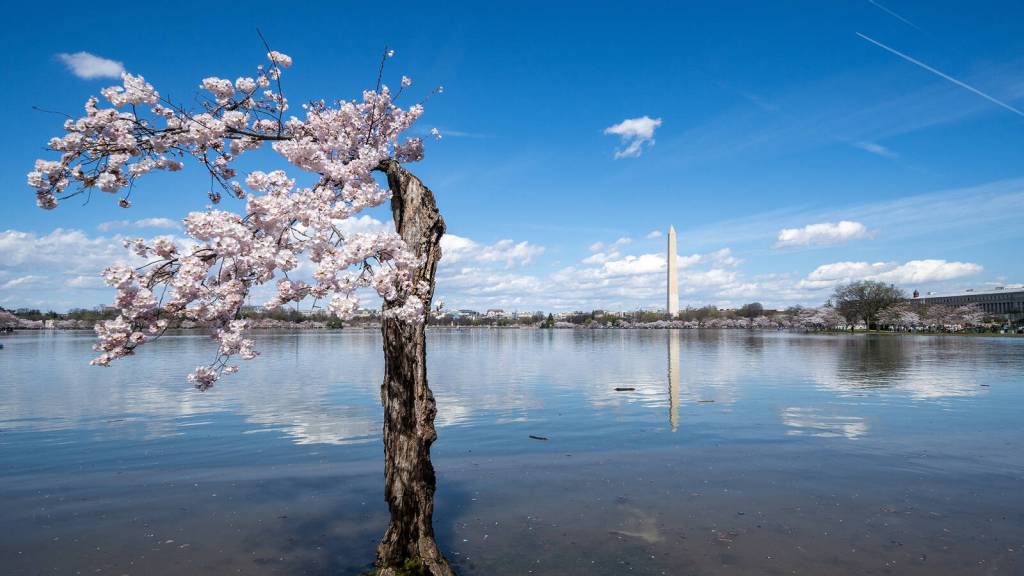
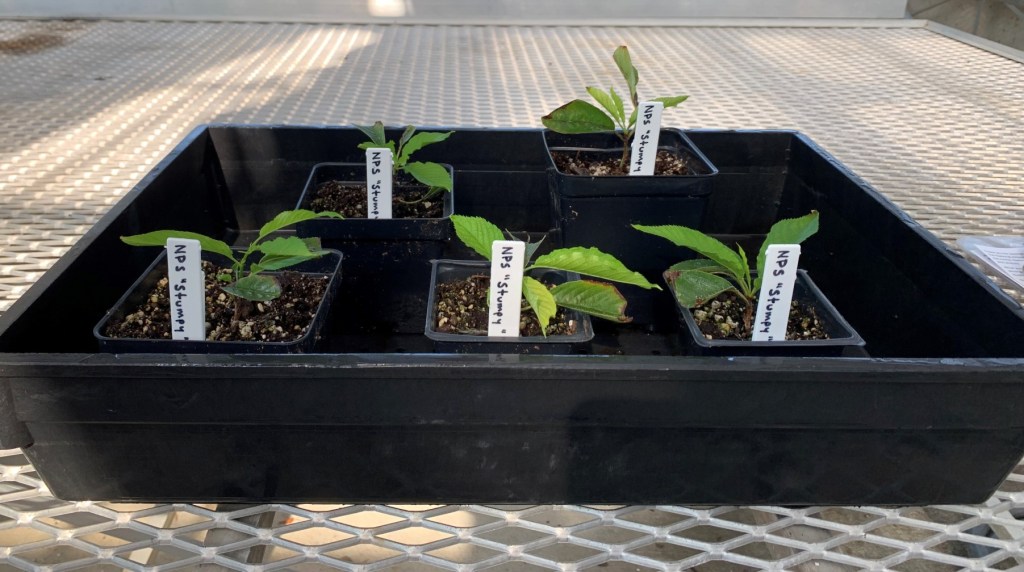
As I alluded to earlier, our main text this morning involves a stump. How many of you have heard of Stumpy, beloved tree of Washington, DC? Stumpy was a cherry tree along the tidal basin, close to the FDR Memorial and facing the Washington Monument. With a mostly hollow and dead-looking trunk, Stumpy still bloomed faithfully every year, becoming a beloved symbol of resilience and perseverance. Stumpy was removed in 2024 due to the sea wall reconstruction at the tidal basin – but its life isn’t over. Five cuttings taken from the original Stumpy have been propagated into baby trees that will, hopefully, survive and be able to take root again along the Tidal Basin.
Perseverance amidst decay and deterioration. Hope for new life and renewal out of something that needs to be cut down, to find repair. These are all themes that apply to the Stumpy scenario and to our Isaiah passage. Today, I want to briefly walk us through the first 11 chapters in Isaiah, to give us some context about the style of book and what Isaiah and his audience would have been thinking of. Notably, many of our most beloved Advent lectionary passages come from the first 11 chapters of Isaiah.
The prophetic book of Isaiah starts out saying that Isaiah served during the Kingships of Uzziah, Jotham, Ahaz, and Hezekiah. For our chapters, the first 3 eras are important. Like other prophets recorded in the Hebrew Scriptures (Old Testament), Isaiah’s messages are given in oracles of judgment and oracles of deliverance and restoration. Prophetic books often have some aspect of a linear storyline but also these rotating cycles of present exhortation and prophecies of judgment alternating with prophecies of future hope and restoration. Reading Isaiah, you can get a lot of whiplash – God speaking softly about the promise of forgiveness, and then the prophet proclaiming “Doom! Woe!” a few passages later.
Throughout these chapters, Isaiah calls the people to account for their unjust actions and faithlessness to God. In chapter 1, Isaiah criticizes how there is a lack of true faithfulness to God – that Yahweh doesn’t want religious ritual when people’s hearts and actions aren’t aligned (chapter 1). Isaiah lambasts the ways that people lie, cheat, swindle, and crush the poor (chapter 3).
We hear Isaiah proclaim “Doom!” for the elite who buy up all the houses so there aren’t places for ordinary people to live, doom for those who live in excess, who defraud, take bribes, and lie. There are times when judgment is foretold against rulers and kings, who trust in plunder or military might (chapters 7, 8). There is “Doom!” foretold to those who make unjust laws (chapter 10) and judgment for all the nations who put their hope in their own strength and violence.
Amidst these oracles of judgment, Isaiah is also gifted with images and messages of a divine future. These visions seem like they would have been something to cling to amidst unbelievably difficult circumstances, like the terror of a looming Assyrian invasion, the pain of unjust social practices, and a weak and ineffective king. Amidst judgment, we see a yearning for a new future. In Isaiah 2, we hear of a last day when everyone will come to the mountain of the Lord, when weapons and instruments of death would be turned into instruments of life and agriculture. At that time, unbelievable global harmony will prevail under the reign of God as the ultimate righteous rule. In Isaiah 7, we hear of signs, God using signs of children being born – Immanuel, God with us – as a symbol that God is not abandoning involvement in Isaiah’s world despite the feckless king Ahaz who trusted in foreign armies. In Isaiah 9, we glimpse visions of an end to warfare and a child who will rule under divine leadership: wonderful counselor, mighty God, eternal father, prince of peace. And finally, we also receive these messages from Isaiah in chapter 11.
[read passage]
We read about the stump of Jesse – this means King David’s line, since Jesse was the father of King David.
During the prophet Isaiah’s time, the Davidic Kingship is ineffective. Isaiah is a prophet under weak kings in service to foreign empires like Assyria. These are kings who fail to live up to the standards the LORD Yahweh has provided for them: these kings choose not to create the conditions for justice and wholeness for all people, these kings allow conditions such as those Isaiah described, where the poor are trampled on and real estate speculators have made it that there’s no place for ordinary people to live.
Isaiah describes this Davidic Kingdom is a stump. It has been chopped down figuratively – there’s dead leadership, no life. And yet, miraculously, out from this stump of Jesse (David’s dad), a shoot will grow up. A branch will sprout from the roots. There will be a person, a righteous ruler, upon whom God’s Spirit will rest. “He won’t judge by appearances nor decide by hearsay. He will judge the needy with righteousness and decide with equity for those who suffer in the land.” The violent of the land will be subdued by the mouth of this righteous ruler.
The people have suffered and struggled under terrible, wayward leaders who failed to do justice, love mercy, and walk humbly with God. But Isaiah receives this message that failed leadership is not the end of the story.
The healing of the social fabric isn’t the only ramification of this righteous rule. Isaiah paints a picture of unfathomable ecological wholeness. Last week, Rusty spoke about Isaiah 2 and how it would be a miracle if weapons manufacturers like Northrup Grumman or Elbit suddenly said they were leaving the weapons business altogether, only producing life affirming products. Swords into plowshares. Quadcopters into seed sowers. Unbelievable transformation. In a similar fashion, in our passage, we see unbelievable ecological wholeness. Wolves and lambs side by side. Leopards next to goats. Calves and lions eating together. All of these, led by a child. Predators and ruminant animals grazing together. Even a miraculous adaptation where carnivores will eat straw! A kindergartener playing at a snake hole. A preschooler digging around in the serpent’s den. No harm. No destruction, just harmony on God’s mountain. Knowledge of God covering everything like water covers the sea.
Our passage closes with Isaiah saying, the root of Jesse, this righteous ruler, will be a signal to the people and all nations will be drawn into God’s family.
This Sunday in Advent, we lit the candle of hope. Hope involves looking to a future that we cannot see, trusting in the Faithful One who has promised to act in history, to act against injustice, to act against tyrant rulers and unjust laws, to act for unfathomable transformation and wholeness.
In this ritual of Advent, we look back at this ancient yearning for God’s intervention in a world filled of oppression, terror, greed, hatred, and injustice. Isaiah captured the people’s yearning and God’s vision of hope. Someday, they would really see what it meant to have a ruler lead with justice and righteousness. Someday, they’d actually find a new version of the holy garden, maybe not the Eden of before but a new and transformed garden, a place without ecological violence.
We see in this prophetic imagery a yearning God’s intervention in the world. We read these Advent scriptures to practice our hope-making, to put on hope-shaped glasses to see the world, to give ourselves a prophetic imagination that God can do something impossible in healing our world.
Our text in Isaiah 11:1-10 guides us into the practice of holy hope. Isaiah’s message here is one of new life after devastation, of a righteous ruler after corrupt and oppressive leaders, of justice for the poor and the meek, of historic enemies being reconciled beyond imagination, of ecological wholeness. This is our Advent hope – that God will deliver, send a sprout out of the stump or the burned tree, raise up a righteous ruler to bring an end to injustice, and that our world will be redeemed and reconciled in almost unfathomable ways, like children, snakes, and lions cavorting.
What are we yearning for, this Advent? In our personal lives and relationships, in our city, in our country, in our world as a whole? When there are bleak surroundings, how do we model Isaiah and craft a vision of what God can continue to do in this world?
Advent is the season where we look to Jesus’ coming, to two Advents: the word made flesh in Jesus Immanuel and Jesus’ coming again to make all things new—in us and through us.
AMEN.
Reference – For more on the origins of Advent, visit this website: https://www.earlychristians.org/the-origins-of-advent/
 Washington City Church of the Brethren